|
MarTech has always been a heavy and fierce battleground for SaaS. Because it is close to money, many ambitious founders will choose the AI + MarTech field when thinking about how to start a business with AI. Recently, Head AI has gained a lot of attention with its release, calling itself "Worlds' First AI Marketer." Today's article is an in-depth interview with Kay Feng, the post-00s founder of Head AI, focusing on: from "how is your ARR calculated" to "what are your barriers". As for Head AI's ultimate dream: "replacing the company's marketing department with AI", Brother Qiang, founder of To B CGO, also expressed his views from the perspective of a practitioner in response to this view, and saw what Brother Qiang's views are in the video!
Next, let's take a look at the conversation between the "Crossroads" team and Kay Feng, the founder of Head AI, and what their views are.
Koji
If you were to give Amway Head AI a sentence, how would you introduce it?
Kay
Just tell Head your budget and website, and it will automatically take care of influencer marketing, affiliate marketing, and cold email — like an AI growth leader who never sleeps, killing the entire marketing department in one person.
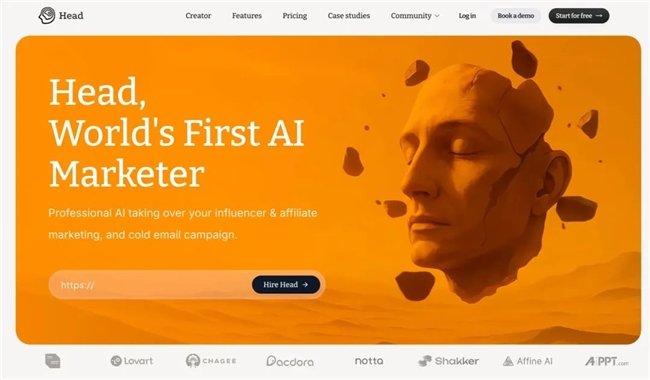
Head AI Official website
Koji
Who is Head AI Target Audience? What problems did Head AI help them solve?
Kay
Head's target audience is divided into three categories:
The first category is entrepreneurial teams, or early brand founders.
They know very well that they have to take the lead, but they have no one in their hands and they don't have much trial and error cost.
What we offer these people is an AI that can "deliver results for you." You fill in the URL and budget, and you don't have to worry about the rest - how to find resources, how to write content, how to talk to talents, how to put it, and the head is fully automatic. In the past, the team might have to recruit a few people to do things, but now occasionally one person can take a look.
The second category is companies with big brands and teams.
Their problem is not that there are not enough resources, but that there are too many people and the process is too heavy to execute.
Leng Qi a new product, just go through the approval process for a week, and by the time the coordination is completed, the traffic has been taken away by others.
We asked them to use the head to directly connect "content production", "talent negotiation", and "cold start distribution" to the automation link, and then run multiple versions of a campaign at the same time, and finally automatically converge the most effective strategy to expand the delivery1.
The feedback from this type of customer after using it is very direct: "The head is not to improve efficiency, but to directly do a department or agency for me.
The third category is agency, which includes service-oriented companies that were previously delivered by manpower.
In the past, they had to rely on the team to manually help customers talk to talents, send campaigns, collect data, and make reports, which was heavy, miscellaneous, and unprofitable.
Now they have handed over this entire section to Head Run, focusing only on "customer service" and "the part with heavy labor value", which is equivalent to outsourcing the delivery to AI, and retaining the highest value density that people can do.
In the past, they relied on manpower to deliver, today they rely on Head to deliver.
From outsourcing to AI-driven intelligent service providers, efficiency and profits have been increased exponentially.
These three types of users look different, but the essence is the same: they are all transitioning from "relying on people" to "relying on systems", and wanting to grow becomes lighter, faster and more certain.
What we do is to run this AI growth system, so that any brand, service provider, or team can have an AI growth engine that automatically executes, automatically optimizes, and scales from scratch.
Koji
Head AI has received investment from Jinqiu, and it is also a company that Zhu Xiaohu invests in and often pays attention to. How did you pitch them to invest in you?
Kay
It's not so much how we pitch, it's that they really understand what we're doing.
This project cannot be voted by "consensus", and there is a threshold for understanding it. In the marketing industry, there are indeed many pitfalls - if you don't see deeply and thoroughly, it is easy to step on thunder. Many institutions dare not touch it again after stepping on it. But as Zhu Xiaohu said: Chinese investors never make money by consensus.
We especially like our investors, who are very at the same frequency and help us a lot.
Jinqiu's Yang Jie, Tianyu and Zhiyuan, their entire team has a very deep understanding of talents and commercialization. The first time we talked, Yang Jie gave TS a decision in less than 30 minutes, and it was also the accumulation in the previous company that allowed them to see the opportunities behind it at a glance.
Mr. Zhu Xiaohu is even more ruthless, he knows social media and marketing too well, and he is often the first to transfer hot posts in the industry to me, surfing with high intensity, and always active on the front line. Daisy is the same, with accurate judgment, quick action, and really standing with entrepreneurs.
Koji
What is the most impressive or surprising problem you encounter during the financing process?
Kay
The two questions that surprised me the most during the financing process were:
"If you don't go to college, will it affect your work?"
"You are so young, will the team disobey you?"
To be honest, these two problems have never bothered me in reality.
If "young" and "not going to college" are really thresholds, then the threshold of this world is too low.
These two things are precisely the proudest choices I am most proud of - I always walk on my own judgment.
The real difficulty is not to write a standard resume,
Instead, it is necessary to achieve results in a very short period of time, and to ensure that this direction is still established in 5 or 10 years.
Someone asked me a while ago:
Is the post-00s individual mentioned in "How to Identify a Person Worth Investing in at the Age of 20" who worked as a co-founder and later started his own business a few years later, you?
It's me. I know many people didn't understand me at that time. But I never expected to be understood from the very beginning.
For true entrepreneurs, the apparent "disadvantages" are never a problem,
Sometimes, it's actually your talent in this field.
We are accustomed to forging a path through adversity, accomplishing tasks that others deem impossible.
I want to leave this passage to the young people who are still on the journey:
Many people have already aged.
It's not your problem if they don't understand you.
You don't need to be understood right from the start,
As long as you keep running, someone will eventually catch up and understand you.
Whether it's Wang Ning, us, or anyone who has been underestimated in the past,
As long as you do the right thing, you will definitely win in the end.
The evaluation system of the general public in this world is -
Not being popular is the original sin, and once you become popular, everything is right.
Finally, I would like to share a quote from Teacher Yu Hua to those who are still on the journey:
When you leave home at the age of eighteen to travel far, you will eventually come into conflict with the world, even if you end up with a black eye and a swollen face.
In the still of the night, let your heart escape from your chest, mend it yourself, and then sleep. The next day, you will be full of confidence again.
It doesn't matter if no one asks, one shouldn't be afraid of being overlooked.
Try to calm down. The mind can rest, but the hands cannot stop.
Continue to do what needs to be done.
True growth is not the absence of breakdowns, but moving forward despite them.

Before I got busy, I often went rock climbing and ran Spartan races.
It's not about winning anyone, but about forcing myself to confirm over and over again that I am not someone who easily gives up.
My hands and feet are often injured, but the more painful they are, the more alert I become.
What I'm addicted to is not victory, but the feeling of almost giving up, yet still pushing through.
Koji
In the latest trend discussion by Sequoia Capital in the United States, it was mentioned that in the AI era, toB products are paid based on results, and Head AI has also adopted this approach. What considerations did you have in mind?
Kay
Head has insisted on "Pay for Outcome" from day one, which is a strategic path we actively chose and stems from my core desire as a marketing leader in the past.
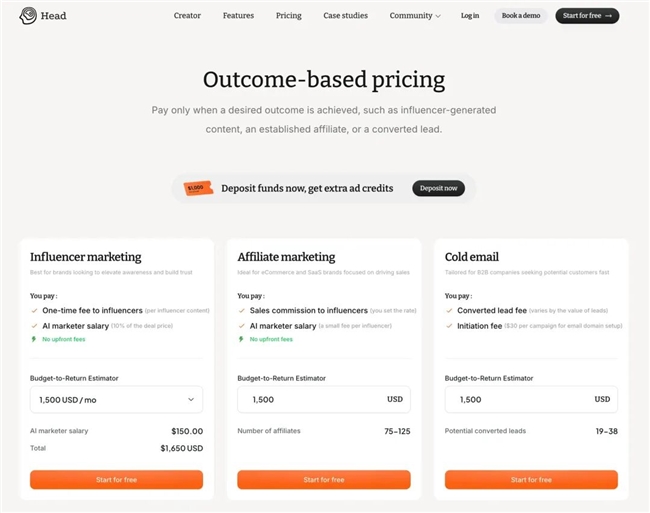
Head AI pricing model
Because I am all too aware of the pain points of traditional SaaS tools: you pay for them, but you have to assemble a team, collect data, find resources, and manage deployment, and in the end, the results may not be satisfactory.
What the market leaders care most about is actually just one thing - "Can you help me get the results?"
So when we are working on the Head, we set a standard:
Customers are not here to rent a set of software, but to hire an AI that can drive growth.
What we do is automated execution, not auxiliary operation. If we can really make the link work, we should be responsible for the results.
If not, then the money shouldn't have been accepted.
The underlying foundation behind this is confidence
We know that what we are building is an AI marketing system capable of completing tasks.
It can indeed automatically find influencers, generate content, negotiate prices, and execute a campaign. We possess this capability, which is why we dare to use results as the pricing anchor.
From a business perspective, this model also binds us more tightly to our customers:
The better the customer conversion, the more we earn; if the customer fails to deliver results, we won't get paid.
This is the relationship we truly want to establish - not as "service providers and purchasers", but as "growth partners who jointly take responsibility for results".
Koji
Are customers more supportive or opposed to the pay-for-result model?
Kay
The vast majority of customers are supportive, and indeed, this can be said to be one of the reasons they chose Head.
The core issue with the traditional SaaS model is that even after paying, you still have to do it yourself.
At Head, "pay-per-result" actually reassures customers because it implies:
You will be responsible for the results, and a 100% refund will be provided if it is ineffective
I don't need any advance trust. I can pay after seeing the results
You dare to use this model only if you are confident of achieving results
Especially for brands with traditional advertising experience, they can better understand this point. They have experienced the pain of buying platforms, recruiting teams, and seeking KOLs but failing to achieve results. Therefore, they are more willing to try a method like Head's: I provide the budget, you deliver the results, and if you deliver, we will continue to increase the budget.
Koji
In Head's pricing model, you emphasize that "pay-per-result + open pricing" represents a revolutionary breakthrough. I notice that you have clearly marked the prices for specific actions, such as "successfully triggering an automated task" and "generating a qualified lead". This is indeed very attractive to product-driven entrepreneurs.
But I'm also curious - did Sierra choose not to disclose pricing in order to accommodate enterprise-level customers, complex target definitions, and high-value transaction processes? In contrast, is Head able to achieve standardization because the product itself is more intelligent, or because it actively avoids those complex but high-value use cases?
Kay
Sierra does not disclose its pricing because they only serve large customers, following a strategy of high-value, low-frequency, and strong service. However, Head's customer structure is completely different - we serve customers ranging from small and medium-sized businesses (SMBs) to listed companies, hailing from over 200 countries and regions worldwide, and our growth rate is very fast.
Under such a scale and pace, if it is not standardized, it simply cannot run.
Therefore, we must break down complex issues at the product level and truly delve into abstraction. This is not because we avoid complex use cases, but because we actively turn complexities into product capabilities.
Today, whether you are a small team of a few people, a fast-growing company like Lovart, or a listed brand like BaWang ChaJi, you can achieve satisfactory results on Head. Small customers can self-initiate, while KA customers have a VIP channel. We have different levels of processes and services, but our pricing system is unified, open and transparent, and pay-per-result.
We truly despise marketing tactics that rely on favoritism, connections, and exploiting gray areas to make money, as they are inconsistent with our values. I hope that the waters in marketing can be a bit clearer and hands can be a bit cleaner. As a platform-based company, this is our fundamental responsibility and commitment.
So we chose this pricing method. It's not just a strategy, but our basic judgment and values towards this industry.
Of course, this also means that we will receive more feedback from people. But we dare to make our pricing public, we dare to be scolded, we dare to be questioned, and we dare to continuously optimize.
Koji
Do you think this openly priced model of Head can be extended to enterprise use cases like Sierra? Or do you think future agents shouldn't take the customized route?
Kay
We believe that "Enterprise" does not equate to "customization", but rather "complex needs that need to be met through system capabilities". Today, we have achieved preliminary verification, and many listed company customers have chosen us for a long time. We attach great importance to KA customers.
It's not that Head can't handle Enterprise use cases like Sierra, but rather that we choose to approach it differently: not by merely relying on human services, but by leveraging stronger product abstractions and the autonomous capabilities of AI agents.
The agent of the future should not be a "customized tool" that requires each client to retrain and reconfigure, but rather a "policy body" that can understand goals, automatically decompose tasks, and flexibly execute within a general framework.
So even for the most complex Enterprise customers, Head can initiate with standardized entry points and pricing, and then extend their exclusive paths through APIs, VIP channels, and policy rules, while maintaining a unified underlying logic. This is the premise for us to scale up quickly and serve users in over 200 countries worldwide.
We believe that future intelligent agents will eventually be like cloud computing - with low entry barriers, strong usability, and complexity being absorbed internally by the platform rather than being passed on to customers.
Koji
I saw Head AI surpass $2.5 million in ARR in 14 days, congratulations! However, there has been a lot of controversy about the calculation of ARR recently.
Kay
Thank you! Indeed, many friends are curious about how this number is calculated.
Our ARR algorithm is actually quite conservative. Given that our weekly revenue has been stable at over $50,000 for the past few weeks, we estimated a lower bound of $2.5 million by multiplying this figure by 52 weeks. We didn't deliberately inflate the estimate; it's based on the actual revenue from user spending.
We choose to disclose ARR because it better represents the true value of the product than metrics such as DAU and registered users - whether people are willing to spend money and continue using it is a more fundamental judgment.
Of course, Head is still in its very early stages and is undergoing rapid iteration. We believe that as long as the product can consistently help customers achieve results, growth will naturally follow.
Koji
Who do you think are Head AI's competitors?
Kay
Head AI has no "competitive products". We are eliminating an old way of behavior.
We are not competing with any specific tool. At least as of today, we haven't seen any company that shares our vision.
We are here to facilitate the evolution of the entire marketing department.
You could say that we are peers with well-known marketing tools like Jasper and Icon, and neighbors with influencer SaaS and cold email SaaS.
But fundamentally, we are not on the same path.
They are still helping humans "improve efficiency", while we are already letting AI directly "take over responsibilities".
Our competitors still rely on tens of thousands of individuals to individually source resources, craft scripts, and monitor the entire growth system.
It's not about tools versus tools, but about species versus species.
Just like a horse-drawn carriage was never a competitor to a car. The competitor to a car is the belief that you still need a horse-drawn carriage.
So we are not fighting the battle of SaaS,
We are challenging a certain perception, a certain organizational approach, and a certain outdated mindset.
Koji
Last week, I met an entrepreneur who mentioned that after using Head AI's products, he was not satisfied with many of the KOL options he received. What is the current rate of KOLs you recommend to customers that are adopted by customers?
Kay
been online for 15 days. However, it already has tens of thousands of users, showing rapid growth and strong viral spread.
As a general-purpose AI marketing product, it is unrealistic to satisfy everyone from day one across different industries, cognitive levels, and languages.
First, let me state the conclusion: we indeed have many imperfections.
The rapid growth has led to imbalances. Not all customers are satisfied today,
But as a founder, what I pay the most attention to is also this issue.
I still spend time reading every piece of user feedback, and I am aware of all the issues and attach great importance to them.
The cornerstone of our ToB company is not high-tech or fancy technology, but whether our customers can achieve results.
To gather feedback and allow more people to criticize us, my email will be sent to all customers, and everyone can directly schedule a meeting with me. We are truly using every possible method to listen: to understand what users think, how they criticize, and how we can make changes.
I completely understand when customers scold us, because growth and marketing are of utmost importance to our company. If something isn't important, people wouldn't scold you at all. Therefore, we should strive to do the best in this important matter.
We messed up a lot of things, especially with our first 100 customers. Maybe 80 of them were dissatisfied.
But it is precisely those "dissatisfactions" that have helped us avoid pitfalls and find the right direction, making today's product work smoothly. Today, there may still be 30 customers who are dissatisfied, but we are making progress. We are iterating rapidly every week and solving problems every week.
We are deeply grateful to our first 100 customers, without whom we would not be where we are today. Even for the negative feedback we receive in public, I am also thankful.
I always believe:
The best response is not to speak, but to do things right.
We even have some customers who have given us three or four opportunities to continue testing and optimizing in a year.
With this trust that truly understands innovation, I only hope we can run a little faster and live up to the expectations of those who have always been willing to give us time.
For example, regarding the hit rate of expert recommendations you mentioned, the current average customer adoption rate is between 30% and 50%. There are indeed bad cases, and we will review each one and quickly optimize them.
There are significant differences in preferences across different countries, industries, budget stages, and users. We are continuously tuning our models, mechanisms, and response processes.
What we do is not to become "search experts", but to make AI truly run a complete campaign.
No one has really succeeded in this before, and we have initially achieved it, but it is far from perfect.
The current repurchase rate, which has not been optimized, is 60%.
For a ToB product that has been online for just 15 days, this is not low,
But we are not satisfied. What we want to do is to build a system capability that can be reused and compounded for a long time.
More importantly, many of our users are themselves CEOs, marketing leaders, growth experts, and business owners.
They constantly provide us with feedback, challenges, and suggestions. The inspiration for some functions and the correction of some judgments are all achieved through their joint efforts.
We never consider ourselves as "serving" customers. More often, we are working side by side with a group of people who truly understand innovation.
That's why we are willing to keep doing it - because although it's difficult, it's worth it.

On the wall of our company, there hangs a photo of a SpaceX Raptor engine. During that test firing, the engine failed to ignite fully and ultimately exploded. We have kept this photo all along.
It's not to commemorate failure, but to remind ourselves: the disgrace is never the explosion, but the never daring to ignite. That's how Head began.
It's not about being foolproof, but about igniting everything and facing the loss of control.
Because all real progress begins with losing control.
Koji
What are the barriers to Head AI? What is the relationship between this barrier and AI?
Kay
1. Bilateral network structure (brand + KOL)
We are not a tool company, but a platform driven by both AI and network structure.
On one end, we have the continuous investment and repeat purchases from our brand clients. On the other end, we have tens of millions of influencers and creators worldwide.
AI plays the role of matchmaking, bidding, gaming, and delivery, continuously optimizing the quality of matches, reducing customer acquisition costs, and enhancing campaign ROI.
This gives us a platform-based competitive advantage:
More brands → More training → More accurate targeting
The more experts there are → the stronger the competition → the lower the price
We are not only a decision-making engine, but also a traffic entry point, and even more importantly, a game scheduler.
2. Decision-making closed-loop capability (AI can move from goal to result)
Most AI tools are used for content generation or strategy assistance, and ultimately, they rely on humans to execute.
Head's AI can make decisions from "you provide the budget and product link" to "find influencers, write scripts, set prices, and launch campaigns", truly forming a closed-loop execution system.
The barrier behind this lies in:
We have connected the information structure of people, goods, and venues
A decision model tailored to the execution logic of the campaign has been established
Introduce game theory and ROI optimization mechanism
3. Data flywheel & self-evolving system
Every execution of a campaign brings real behavioral feedback data, such as:
Whether the influencer accepts it, whether the script passes, how the final conversion is
These data are not passively recorded, but are directly fed into our model training and matching optimization system, forming an internal loop of the decision engine.
This means:
The model is becoming increasingly accurate (with recommendations and quotes more aligned with the scenario)
The system runs faster and faster (the less repetitive work, the higher the conversion rate)
Only AI systems capable of completing the "from decision-making to delivery" process are qualified to collect and learn from all of this.
Koji
You choose to drop out of high school to start a business. If you could do it all over again, would you make the same choice?
Kay
I will.
I think entering the real world early will only bring me benefits, not drawbacks.
While others were still memorizing textbooks, I was already working on the front line to drive growth and earn my first pot of gold.
Many people think that if you don't go to school, you won't learn, but real learning never requires a classroom or supervision.
I learn faster than anyone else because I aspire to achieve genuine results.
Learning is not an obligation, but a personal interest.
So I never feel like I've given up anything; I've just chosen a path of growth with higher intensity.
If I could do it all over again, I would choose the same path,
Only this time, I will run faster and bet even bigger.
Koji
Your WeChat signature is "Scholars also see it as beneficial to the world", I understand that this is expressing a sense of responsibility to "take the world as your own responsibility". I wonder when and why such a vision was born?
Kay
Actually, it wasn't an idea that suddenly popped up at a certain moment.
It was accumulated little by little during my entrepreneurial journey.
I have always considered myself a very fortunate person. Although the pressure on this path is immense, always running at high speed and making breakthroughs, I have indeed witnessed the winds of the times, encountered my own dividends, and truly benefited from them.
But I never take it for granted.
The more fortunate one is, the more one feels compelled to give back.
Since we have obtained it, we should do something valuable and give back to the world.
Since the first year of my entrepreneurship, I often tell people around me, "I hope what I do is meaningful."
Actually, many people didn't understand at that time, thinking that what I said was too vague and premature.
One day, I came across a video by an uploader who quoted a saying by Liu Tongxun, the chief military minister of the Qing Dynasty: "Whether a scholar is useful to society or not depends on whether he can make a difference."
I was truly shocked at that moment.
It's like traveling back in time for centuries, someone has clarified in one sentence the obsession that I've been unable to articulate over the years.
"Will this world become a little better because of me?"
If the answer is "yes", then all the hard work, choices, and even loneliness become worthwhile.
Koji
How many people are on the team at Head AI? What is the configuration?
Kay
Our team consists of less than 20 people
In addition to me and the co-founder, we have 11 engineers (covering AI, backend, frontend, and infrastructure), 3 product and design specialists, and 2 members responsible for growth, operations, and support.
The entire team is highly proficient, with each member capable of independently developing a complete module, from requirements analysis to delivery.
The turnover rate in our company is very high, not to create pressure, but because we have very strict standards for whether a person can "fight in the battle".
Let's look at two things:
Whether one possesses an entrepreneurial mindset and the ability to accomplish tasks.
We don't look at resumes or titles, we only care about whether you can solve problems.
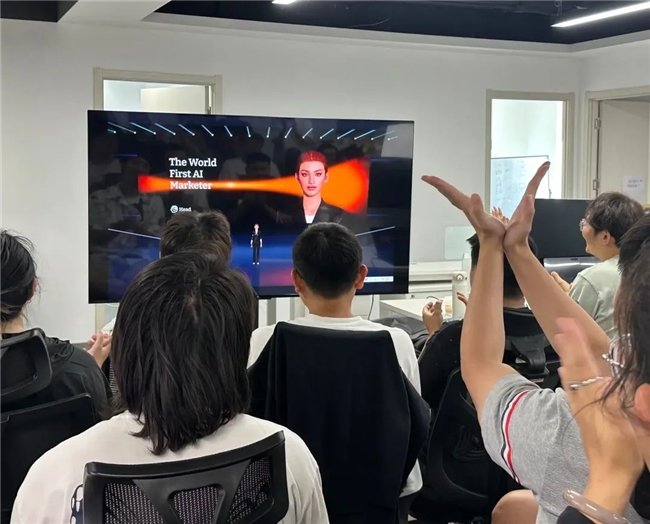
A while ago, we sat in the office, watching Head host a product launch event.
I took a photo while sitting in the corner. That moment felt a bit surreal
It's like watching a life you created yourself standing on the stage alone for the first time.
That is not code, but the continuation of human will.
Watching a group of young people in their early twenties sitting together, they are excited, focused, and radiant,
Standing at the crossroads of this rapidly changing world,
I just feel that it's great to have such a group of people walking together.
Koji
Do you think you guys are a company/organization of AI Native? Why?
Kay
We are a company born for AI.
From day one, Head's focus has not been on "making AI assist human work", but rather the other way around,
We are enabling human assistance for AI to make things work smoothly.
AI determines the advertising strategy, AI leads the selection and negotiation process, AI executes the campaign, while humans only do one thing: set goals and budgets.
We do not regard AI as a tool, but rather as a new decision-making entity, a new species.
We have released a promotional video overseas called "Think Beyond", and its core idea is this:
AI is not a tool; it is a new species. Instead of letting it follow human commands, it would be better to relinquish power and see how far it can go.
This is the fundamental difference between us and the "AI enhancement tools" available in the market:
They are preserving old organizations, while we are building new species of working methods.
This is the true AI Native, which not only employs AI, but also acknowledges its independent intelligence from the bottom up.
Koji
Being a founder and CEO at 20, I guess you're the youngest on the team, right? How do you manage colleagues older than you?
Kay
At Head, no one earns respect based on age or seniority. We have only one criterion: who can get things done.
I have never believed that "being older than me" is a difficult aspect of management. Instead, I have always viewed it as a relationship based on mutual choice.
Those who are willing to join a 20-year-old CEO are not looking for a superior, but rather a direction and a battlefield.
They are not waiting for arrangements, but are proactive in charging forward, fighting and winning together.
I won't "pretend to be mature" or imitate any management routines.
My role is not to stand above and give orders, but to make judgments and bear the consequences in the midst of chaos.
Actually, I've never been "managing people". I only attract those who don't need to be managed and only recognize results.
As for those who are not suitable, I never hesitate to let them go.
When I was 18, I was already shouldering the pressure of leading a team forward at my previous company. At that time, I didn't have the title of CEO,
But I still have to push everything and motivate everyone. When you don't have power, but can still influence others, that's real influence.
So today, this business card with "CEO" on it is just a stamp on the responsibility I have long taken on.
Others may rely on their resumes to win trust, but I prefer to rely on results.
I feel that I have a morbid desire to "succeed".
It forces me to give it my all and forces others to believe in me.
Koji
In the field of AI, what do you think will definitely happen in 2025?
What about within 3 years? What about within 5 years?
Kay
Things that will definitely happen in 2025:
AI is no longer just a suggestion tool, but a direct operator of marketing.
Writing copy, negotiating with influencers, sending cold emails, and running ads—AI can already execute these tasks in a closed loop. It's not "assisting humans," but rather "replacing actions." Within the marketing department, AI can already replace multiple positions. The bosses are smart: one AI agent can handle the workload of a team that used to work for a week, without taking leave, changing jobs, or attending inefficient meetings. For small and medium-sized companies, this is not a wave of technology, but a basic necessity for survival.
Within 3 years (by 2027):
Companies without AI-native structures will face a significant gap in survival.
Just like brands that missed the era of social media gradually falling behind, companies without an AI-native growth stack (automatic decision-making + automatic execution) in the future will be trapped in the dilemma of "low human efficiency + expensive budget + slow decision-making". AI is no longer a tool for efficiency improvement, but a "structural dividend" that sets the upper limit for growth. This is not a matter of choice, but a matter of being forced to reconstruct sooner or later.
Within 5 years (by 2030):
Organizational structures will be completely restructured around AI.
In the future, companies will not adhere to the "one person, one position" model, but rather adopt an approach where "AI + a small number of humans serve as optimizers". A Head AI can replace a large number of repetitive tasks in the marketing department, and the company will only retain the most critical roles: strategic judgment, quality control review, and model adjustment. AI will be the main force of execution, while humans will play a supporting role. Organizations will become increasingly flat, faster, and more automated.
|

 Home > News >